
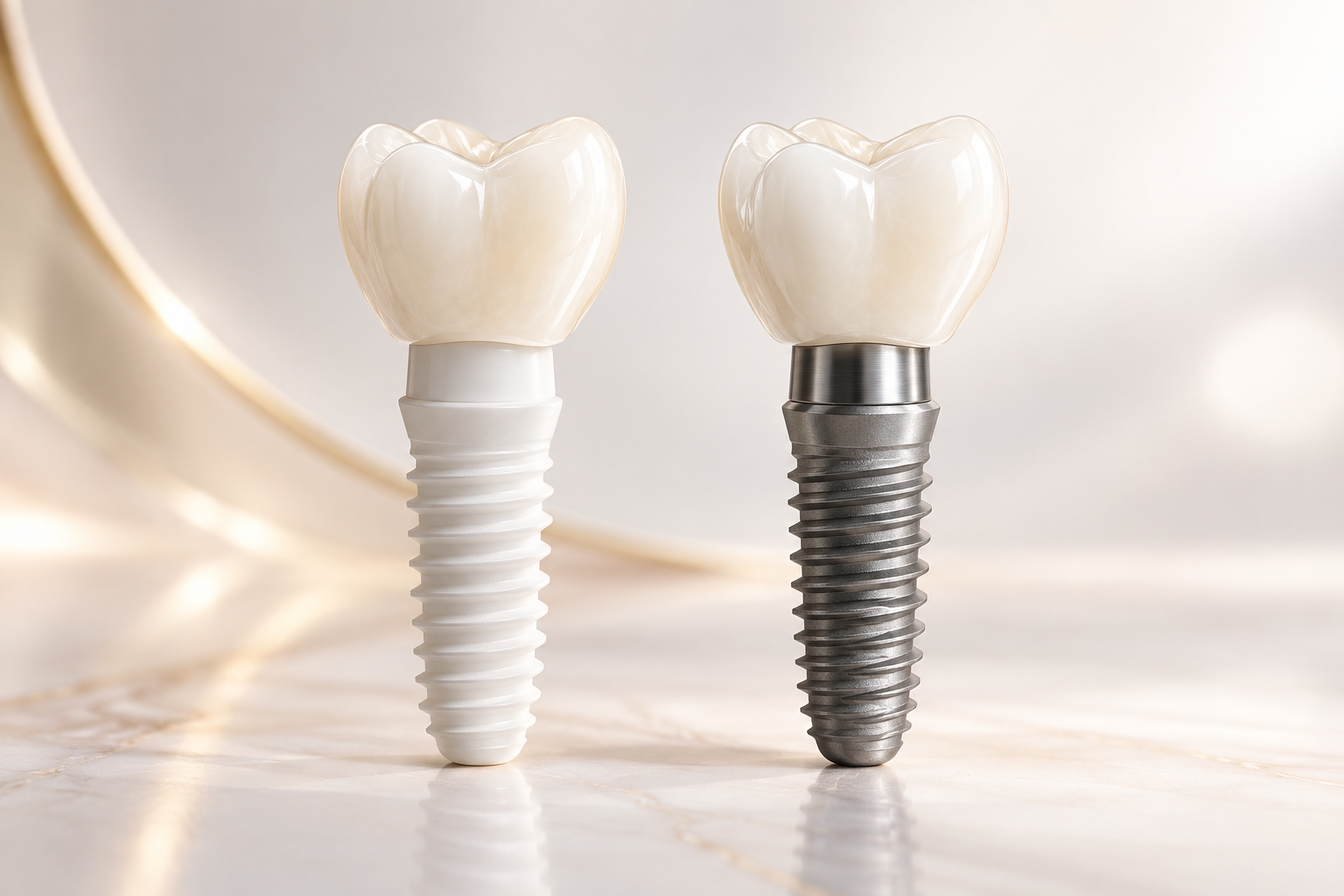
Are you looking for metal-free dental implants in Malaysia? Zirconia dental implants are becoming an increasingly discussed option among patients who prefer ceramic dental materials, natural-looking restorations, and a more holistic approach to oral healthcare.
For decades, titanium dental implants have been the standard treatment for replacing missing teeth. Their excellent clinical success rates, durability, and extensive scientific research make them a trusted option in modern dentistry.
However, with growing interest in functional dentistry, biological dentistry, and metal-free dental treatments in Malaysia, more patients are asking about zirconia implants.
What makes zirconia different from titanium? Are ceramic implants healthier? Who should consider them, and what are their limitations?
This guide explains everything you need to know before choosing between zirconia and titanium dental implants.
What Are Zirconia Dental Implants?
Zirconia dental implants are made from zirconium dioxide, a high-strength ceramic material used in modern dentistry.
Unlike traditional titanium implants, which are metallic and grey, zirconia implants have a natural white colour that closely resembles a tooth.
This makes zirconia an attractive option for patients who want a metal-free dental implant or are concerned about the appearance of metal beneath thin gum tissues.
Zirconia and titanium implants work in fundamentally the same way. Both are inserted into the jawbone to replace missing tooth roots. Over time, bone integrates with the implant surface through a biological process known as osseointegration.
Once healing is complete, a dental crown or bridge can be attached to restore chewing function, appearance, and comfort.
The main difference is the material used, along with the available implant designs and restorative options.
Why Are Patients in Malaysia Interested in Metal-Free Dental Implants?
Interest in metal-free implants often comes from patients who want a different approach to dental materials and long-term oral health.
For some individuals, the preference is aesthetic. Others may be concerned about potential material sensitivities or simply prefer ceramic restorations.
Patients exploring functional dentistry in Malaysia may also be interested in how dental materials, gum health, bite alignment, and general health considerations fit into their treatment plan.
Zirconia implants provide a ceramic alternative that may be appropriate for some of these patients.
However, it is important to distinguish personal material preferences from established medical benefits. There is currently insufficient clinical evidence to conclude that zirconia implants are generally healthier or safer than titanium implants.
What Is the Role of Zirconia Implants in Functional Dentistry?
Functional dentistry is a term sometimes used to describe a patient-centred approach that considers oral function, dental materials, gum health, bite relationships, and other relevant health factors.
It is often associated with interest in biological or holistic dentistry.
In Malaysia, however, functional dentistry is not a separately recognised dental specialty under the Malaysian Dental Council's published list of specialties.
A responsible functional approach to implant treatment should still follow established clinical principles.
1. Biocompatibility of Dental Materials
Both titanium and zirconia demonstrate excellent biocompatibility.
Zirconia may appeal to patients who prefer ceramic materials, but titanium is also highly compatible with human tissues and is well tolerated by most patients.
2. Healthy Gum and Bone Integration
Successful dental implant treatment requires stable supporting bone and healthy surrounding gums.
Both implant materials can support favourable tissue integration.
Although some laboratory studies have investigated differences in bacterial adhesion, current clinical research does not establish that zirconia implants consistently prevent peri-implant infections better than titanium implants.
3. Restoring Proper Chewing Function
Implants should restore more than the appearance of missing teeth.
The position of the implant, crown design, bite forces, and chewing function all influence long-term treatment success.
These considerations are particularly important for patients who grind their teeth or have complex bite problems.
4. Individualised Treatment Planning
A patient-centred approach considers medical history, gum health, bone availability, aesthetic requirements, material preferences, and long-term maintenance.
Choosing zirconia simply because it is labelled "metal-free" does not automatically produce a better treatment outcome.
The goal should be to select the most appropriate implant system for each patient's clinical needs rather than assume that one material is universally superior.
Benefits of Zirconia Dental Implants
1. A Metal-Free Ceramic Implant Option
One of the main reasons patients search for zirconia implants in Malaysia is their preference for non-metallic dental restorations.
Zirconia is a ceramic compound, rather than metallic zirconium.
For individuals who prefer to avoid titanium dental implants, zirconia offers an alternative.
However, not every zirconia implant system is completely metal-free. Some two-piece zirconia systems use internal titanium screws or other metallic components.
Patients seeking an entirely metal-free restoration should ask their dentist about the material composition of every component, not just the implant body.
2. Natural Aesthetics, Especially for Front Teeth
Zirconia's white colour can offer an aesthetic advantage when replacing visible teeth.
In patients with thin gums, the grey colour of titanium can sometimes affect the appearance of the surrounding tissues.
A white ceramic implant may reduce this particular concern.
However, beautiful results also depend on the surrounding bone, gum thickness, implant positioning, and crown design.
3. Good Tissue Compatibility
Zirconia is well tolerated by oral tissues and can integrate successfully with the jawbone.
Research supports favourable peri-implant tissue outcomes with appropriately selected zirconia systems.
Both zirconia and titanium can, however, experience inflammation, bone loss, and other complications if treatment planning or maintenance is inadequate.
4. Encouraging Clinical Survival Rates
Clinical research has reported promising outcomes for zirconia implants.
A 2023 International Team for Implantology consensus review reported an estimated 97.2% five-year survival rate for zirconia implants in the studies examined.
These results are encouraging and broadly comparable with published titanium implant outcomes for selected applications.
However, this evidence mainly concerns certain one-piece zirconia implant systems. Titanium continues to have substantially more long-term clinical data.
Who Is Suitable for Zirconia Dental Implants in Malaysia?
Zirconia implants may be particularly relevant to patients with the following preferences or clinical situations.
Patients Seeking Metal-Free Dental Implants
Patients who prefer ceramic dental materials may consider zirconia, provided their bone and bite conditions are suitable.
This preference may be related to personal values, previous experiences with dental materials, or interest in biological dentistry.
Patients Replacing Front Teeth
For patients with thin gum tissue or high aesthetic expectations, zirconia's tooth-coloured appearance may offer a cosmetic advantage.
Patients With Suspected Titanium Sensitivity
True titanium hypersensitivity is considered uncommon, but patients with a convincing history of material-related reactions may discuss ceramic alternatives with their dentist.
Any suspected allergy should be carefully evaluated rather than assumed.
Patients With Straightforward Implant Requirements
Clinical evidence is strongest for selected zirconia systems used in single-tooth restorations and short fixed bridges.
Patients with sufficient bone, favourable implant positioning, and well-controlled biting forces may be suitable candidates.
What Are the Drawbacks of Zirconia Implants Compared With Titanium?
Despite their advantages, zirconia dental implants have several important limitations.
1. Less Long-Term Scientific Evidence
Titanium dental implants have decades of documented clinical use, including research following patients for ten years or longer.
Zirconia implants have promising clinical outcomes, but fewer long-term studies are available, particularly for newer two-piece systems.
For patients who prioritise a lengthy clinical track record, titanium remains the more established material.
2. Higher Brittleness and Mechanical Limitations
Zirconia is strong, but it is a ceramic and therefore more brittle than titanium.
Titanium can tolerate deformation under mechanical stress, while zirconia has less ability to bend before fracturing.
Clinical studies of selected one-piece zirconia implants have not shown a higher fracture risk over five years, but this does not establish identical durability for all designs and clinical situations.
Implant diameter, manufacturing quality, and biting forces remain important factors.
3. Less Flexibility for Angled Implants
Many established zirconia systems have a one-piece design.
This means the implant and the component supporting the crown form a single structure.
If implant positioning is unfavourable, correcting the angle of the final restoration may be more challenging.
Titanium systems generally provide more restorative options, including angled abutments and a wide selection of components.
Newer two-piece zirconia implants improve flexibility, but long-term clinical evidence varies between systems.
4. More Limited Options for Complex Treatments
Titanium implants are widely used for single-tooth replacement, multiple missing teeth, implant-supported bridges, and full-arch rehabilitation.
Although zirconia implants can be used in some more complex situations, evidence and component availability may be more limited.
For patients requiring significant angulation correction, complex reconstructions, or full-mouth rehabilitation, titanium may offer a more established and flexible treatment approach.
5. Potential Cement-Related Problems
Some one-piece zirconia implants require a cement-retained crown.
If excess cement remains beneath the gum, it can contribute to inflammation and other complications.
Careful crown design and cement removal are therefore essential.
Titanium implants commonly support screw-retained restorations, which can simplify certain aspects of maintenance.
6. Higher Cost of Zirconia Implants in Malaysia
Patients comparing ceramic and titanium implants in Malaysia should be aware that zirconia treatment may cost more.
Prices vary depending on the implant brand, clinical complexity, surgical requirements, and prosthetic components.
A quotation should clarify whether it includes the implant fixture, abutment, crown, imaging, and any additional procedures.
It is important to compare the complete treatment plan rather than the implant material alone.
Are Zirconia Implants Healthier Than Titanium Implants?
Patients researching biological dentistry or functional dentistry often ask whether zirconia implants are healthier because they are metal-free.
There is currently no convincing clinical evidence that zirconia dental implants are universally healthier than titanium implants.
Both materials are highly biocompatible and capable of successful bone integration.
A 2026 systematic review found no significant overall difference in the incidence of peri-implant mucositis or peri-implantitis between zirconia and titanium in the included comparative studies.
Therefore, patients should not assume that ceramic implants are automatically free from inflammation or other complications.
Long-term implant health depends on gum health, adequate bone support, proper positioning, oral hygiene, smoking status, medical risk factors, and regular dental maintenance.
